

Circular ownership refers to a corporate structuring method where companies own stakes in each other, forming a loop of control. This occurs when one company holds shares in another, which in turn owns shares in the first—creating a circular or indirect ownership pattern. These structures often involve more than two entities, which can make it difficult to identify the ultimate beneficial owners (UBOs).
Such arrangements can serve legitimate purposes like risk management or tax planning. However, they can also be exploited to obscure ownership, evade regulations, or hide the involvement of a sanctioned person or high-risk shareholder. That’s why identifying circular ownership can be important to risk and compliance teams when conducting due diligence.
At its core, circular ownership is a network of ownership relationships where entities indirectly own or control each other in a loop. While not illegal, these structures can be used to exploit regulatory loopholes and conceal the identity of the beneficial owner.
For example, a person may appear to hold only a small stake in a company—well below the threshold for disclosure—but through a network of interconnected entities, they may still have significant ownership and/or exert control. This makes it difficult to detect their influence without thorough investigation.
Moody’s Shell Company Indicator has flagged more than 61,000 entities globally with circular ownership patterns, highlighting the scale of the challenge, and also the potential for misuse in financial crime, sanctions evasion, and money laundering.
Key to understanding circular ownership is understanding beneficial ownership.
A beneficial owner is defined by the FATF as: “...the natural person(s) who ultimately owns or controls a customer and/or the natural person on whose behalf a transaction is being conducted. It also includes those persons who exercise ultimate effective control over a legal person or arrangement.”
Using circular ownership, individuals can try to exploit loopholes in beneficial ownership regulations to create complex and opaque networks of control. An individual may, for example, hold minimal shares or voting rights in a company—well below the threshold for being considered a beneficial owner—but by structuring a chain of ownership where each entity controls the other, they manage to effectively maintain control while avoiding scrutiny.
Understanding who the ultimate beneficial owners (UBO) of a business are can be achieved through access to beneficial ownership data held in third-party databases, such as Moody's, and in commercial registers, financial authorities, and tax offices around the world.
To provide an example of circular ownership, imagine Person 1—Jane Doe—holds a minimal number of shares and voting rights in Company A, falling below the 25% threshold for beneficial ownership identification set out by FATF and adopted in many regions.
Unbeknown to regulators and compliance teams, Jane also exerts significant control over other companies linked to Company A through a circular ownership structure. Through a network of complex ownership, Jane is effectively the beneficial owner of Company A, even though this would not be obvious without investigation.
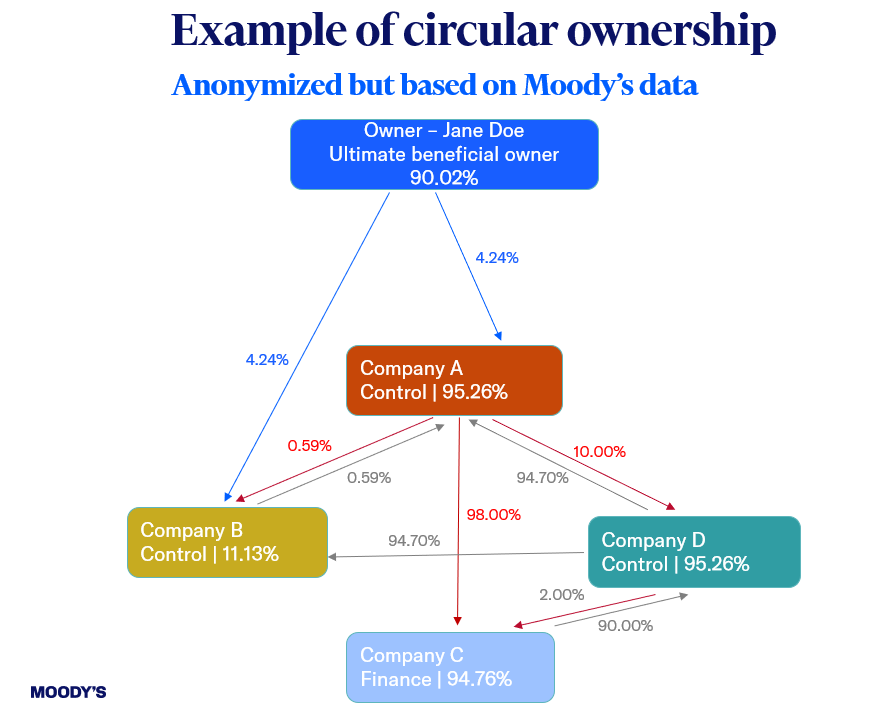
Owner, Jane Doe, ultimately owns 90.02% of the focal company—Company A—despite only having a direct stake of 4.24%.
Such complex ownership arrangements, particularly when compounded with numerous layers of intermediary entities across different jurisdictions, can create a barrier to uncovering Jane’s identity as the ultimate beneficial owner (UBO), and therefore what risks she may in fact pose.
Criminals and sanctioned individuals create and exploit circular ownership structures to launder money, evade taxes, finance terrorism, and engage in other illicit activities, shielded by convoluted structures.
These complex corporate structures can be made more transparent with access to the right data, tools, and analytics solutions.
It’s possible to identify likely instances of circular ownership and build this data into risk assessments, compliance, and risk monitoring processes. As discussed, Moody’s has identified circular ownership patterns through its Shell Company Indicator tool.
Of the 472 million companies Moody's analyzed in November 2023:
For those working as part of a compliance, risk management, or anti-financial crime team, this may be key data to include in due diligence and enhanced due diligence processes.
To effectively manage risks posed by circular ownership, compliance teams can consider adopting a multi-layered strategy that combines data-driven insights, regulatory alignment, and technology-enabled workflows. This cab begin with integrating beneficial ownership data into onboarding and ongoing due diligence processes, so institutions can better detect indirect control and hidden relationships.
Cross-functional collaboration between compliance, legal, and data teams may also help to interpret complex structures.
Leveraging tools like Moody’s Shell Company Indicator can help flag entities exhibiting circular ownership traits early in the customer lifecycle. Additionally, implementing risk-based segmentation can help compliance teams to prioritize investigations based on jurisdictional risk, industry exposure, and ownership complexity.
Advanced risk assessment strategies may include scoring models that weigh factors such as:
Regularly updating internal policies and screening thresholds to reflect evolving regulatory expectations—particularly around UBO disclosure, sanctions, and cross-border entity structures—may also help strengthen strategies.
Moody’s Shell Company Indicator uses 7 risk themes—including circular ownership—to flag suspicious corporate behaviors. This can help businesses uncover indirect control, atypical directorships, and other red flags during onboarding, due diligence, and monitoring.
In addition to helping understand risks related to circular ownership, Moody’s can also provide access to comprehensive beneficial ownership data organizations can use in their UBO identification and verification processes.
By mapping complex ownership structures and highlighting hidden relationships, organizations can gain a clearer understanding of who truly controls an entity. Financial institutions and other regulated entities can make identifying possible instances of circular ownership part of managing AML compliance and assess risk to make better informed decisions about who they are working with.
Organizations worldwide can create greater transparency and better identify instances of potential circular ownership using Moody’s Shell Company Indicator. Along with our UBO and entity verification data, Moody's solutions can support screening, due diligence, and enhanced due diligence processes.
If you would like to know more about our compliance and third-party risk solutions, please get in touch—we would love to hear from you any time.
Disclaimer: This content is for informational purposes only and reflects our understanding of the subject matter as of the date of publication. It does not constitute legal, regulatory, or compliance advice.