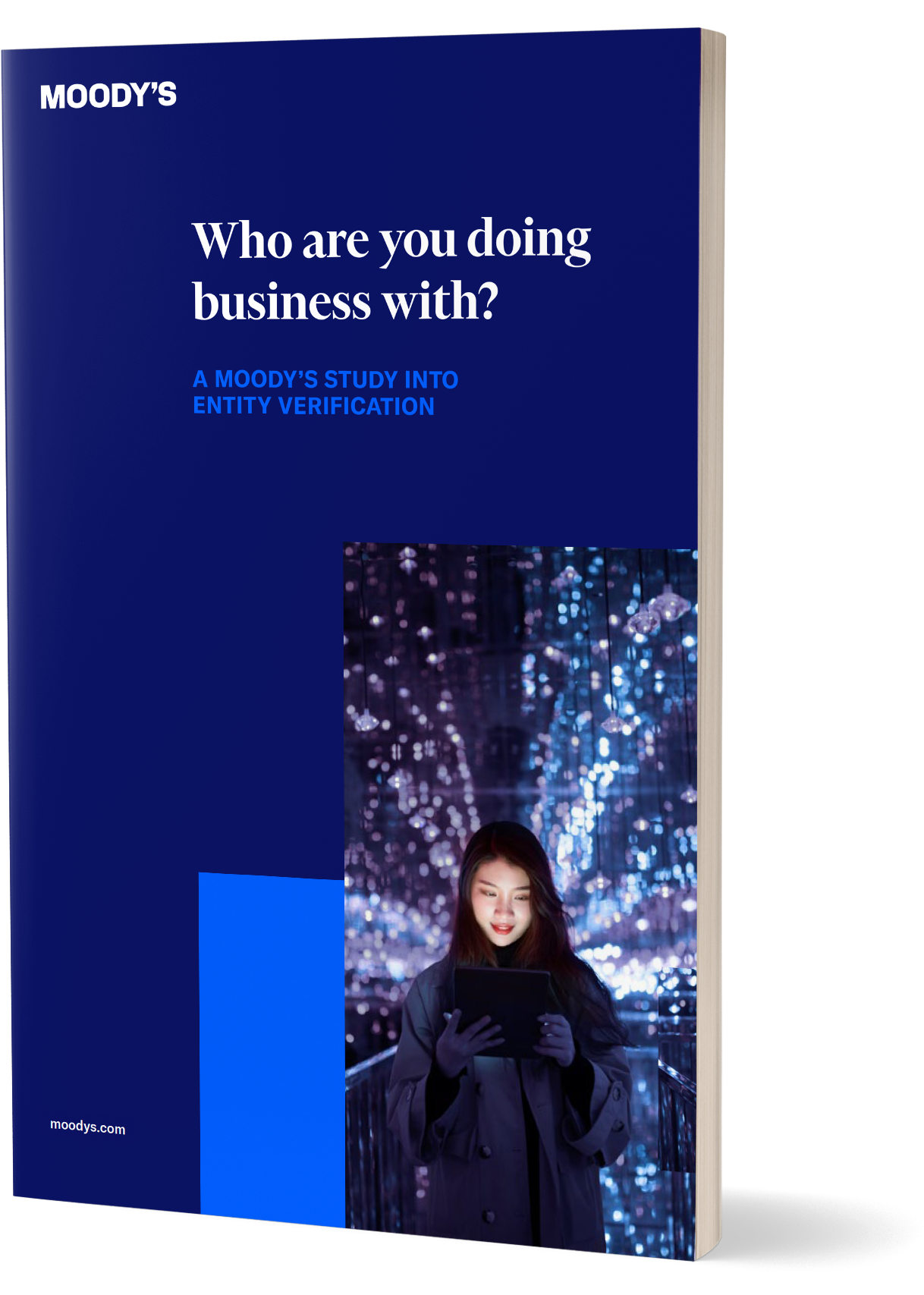
Who are you doing business with?

Entity Verification

Get new levels of certainty on risks associated with third-party entities and clarity on their ownership structures. We have the most extensive company and corporate structure data globally, combined with sanctions and adverse media data to help you create corporate transparency and an insightful picture of risk.

Bring the data you need together via a single solution to answer the question - who am I doing business with? 


Single source of data

Entity Verification API


With Moody’s Entity Verification API, you can access dynamic entity data from a network of commercial registers and financial authorities from 200+ countries, curated details on over 500 million global companies, and a comprehensive risk database.

Organizations often have to seek out different sources for all the necessary data to conduct business. Through a single source, our configurable solution can be used to support customer onboarding, client lifecycle management, perpetual KYC, third-party risk management, fraud prevention, and more.


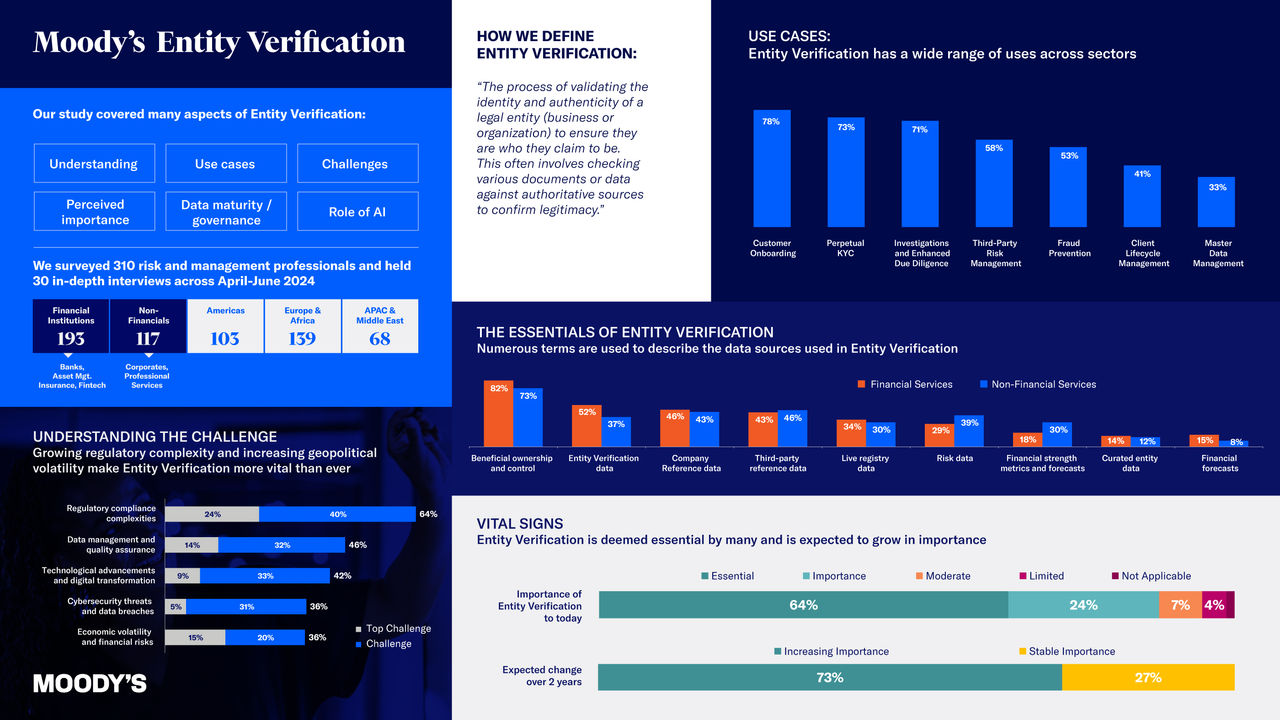
Moody's Entity Verification infographic

Entity Verification searches and understanding beneficial ownership


To understand who the ultimate beneficial owners of a business are look no further. Our solutions show you more than 1.9 billion ownership links, 1.7 billion historic ownership links, and 218 million active ownership links.

Automate business Entity Verification searches. Access data and documents from official sources dynamically that are timestamped for audit. And achieve this through a single solution as the bedrock for due diligence.

Review a corporate group in its entirety. Our corporate trees reveal the ownership of your potential and existing business partners and third-party associates anywhere in the world. We can also help you understand instances of indirect ownership and control, and circular ownership in your counterparty network.

Establish trust in the entities you work with.


Dynamic, timestamped data access for Entity Verification


Our access to a global register network provides you dynamic information searches to identify corporate entities and verify their business details. These details include:

  • registration number
  • registered name
  • address
  • directors and officers
  • status
  • original documents from official sources, such as register extracts, annual accounts, articles of association and more. 

You also have access to other essential tools like a Tax ID verifier, which allows you to verify a customer’s VAT numbers, EINs, and TINs.

With dynamic connections to government registers and financial authorities around the world, official and authoritative company information is a click away. The entity data and documents retrieved from our comprehensive network are delivered to you timestamped and unaltered, ensuring AMLD qualification. You get instant access to more than 328 million companies, with more than 5.5 billion company filings available for on-demand retrieval that is accurate to the second.





Unrivalled data

Know your business (KYB) processes

Make decisions about the entities you work with having created a picture of risk you can trust. With unrivalled access to a world of business data, we offer a streamlined approach to complex and detailed Know Your Business (KYB) checks.

Access company information with worldwide coverage and decode complex shareholder structures. Automate anti-money laundering and counter-financing of terrorism compliance with a holistic, digital suite of services that makes completing KYB tasks easier.

Our entity and ownership solutions give you access to leading sources of company data to enable Entity Verification and AML compliance qualification. Whether you need to source original documentation dynamically that is timestamped or automate onboarding and risk monitoring processes with the help of structured entity data, including ownership information and financial strength metrics and forecasts, our solutions provide uninterrupted access to the KYB data you need to make decisions with confidence.


Five steps in the Entity Verification process made easier through automation

Moody's can help automate business Entity Verification processes, so you understand who you are doing business with and the risks of doing business with them.


To verify the official ownership of an entity, these five steps may be taken:

  1. Reviewing corporate documents: Examining official documents such as articles of incorporation, shareholder agreements, and corporate bylaws can help confirm ownership structure.
  2. UBO identification and screening: Investigating the identity and background of key individuals associated with a company, such as directors, officers, and major shareholders, to provide insight into ownership and control, and associated risk.
  3. Analyzing financial statements: Reviewing financial reports and statements can reveal ownership interests through shareholdings or equity stakes. It can also help understand shell company risk.
  4. Using public records: Searching public databases, such as corporate registries and securities filings, can help verify ownership information.
  5. Enhanced due diligence on key personnel: In-depth screening of company representatives or stakeholders can provide additional clarity on control and ownership arrangements.

Combining these methods to conduct thorough due diligence and Entity Verification, organizations can more effectively identify who owns an entity, and ensure they comply with anti-money laundering laws, sanctions requirements, and other regulations.


Original study from Moody's

Entity Verification Report

Welcome to our newest report on Entity Verification. This global study highlights the increasing significance of Entity Verification in managing risk and overcoming data challenges in today's regulatory and risk environment.

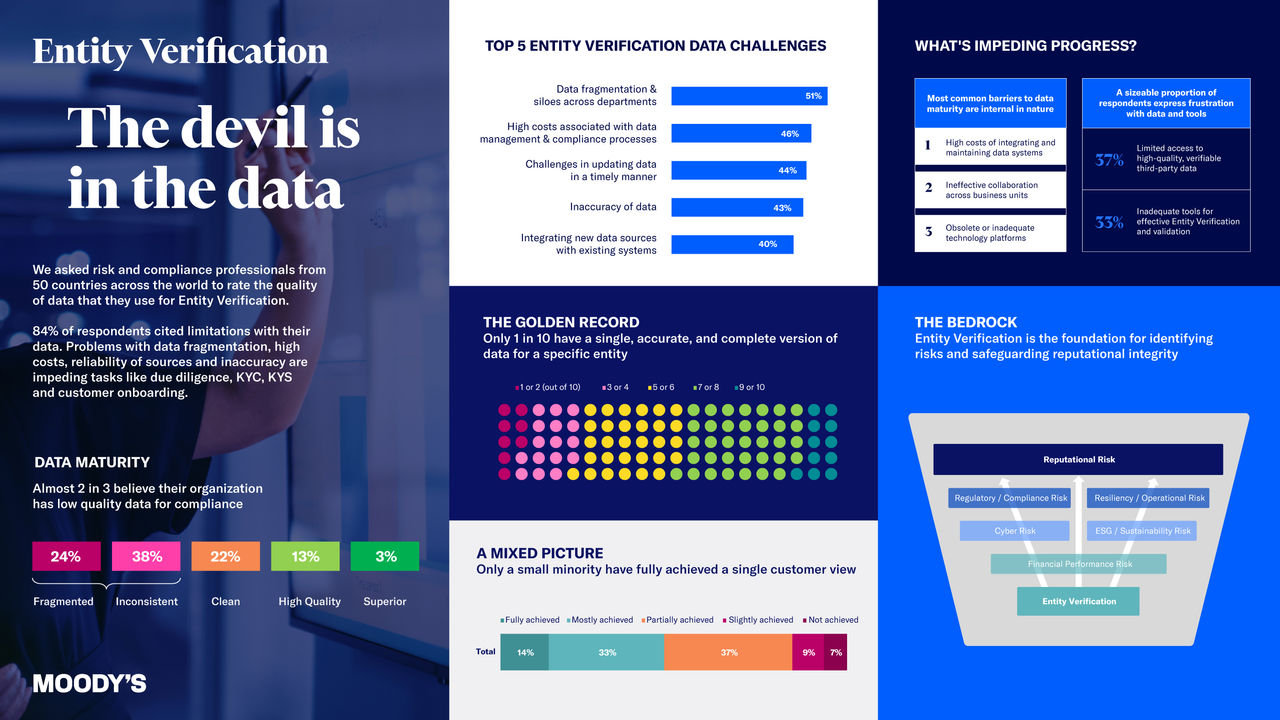
Download the report to learn what more than 350 risk and compliance professionals said about their Entity Verification challenges, data governance, the rise of AI in Entity Verification, and how senior leaders are prioritizing Entity Verification. 


The devil is in the data infographic


A global Entity Verification case study

Woman smiling
Continuation of woman smiling image


This case study highlights how a prominent global client transformed its KYC procedures using Moody's Entity Verification API. By integrating this innovative solution, the client sought to streamline operations and improve efficiency across its investment and commercial banking teams.

Our Entity Verification API is serving as a reliable source for up to date and authoritative entity data, facilitating automated onboarding and ongoing KYC compliance.


Entity Verification webinar: Who are you doing business with?

Entity Verification is the bedrock for knowing who is in your third-party network and gaining clarity on associated risks. It also links to other key processes like customer and supplier onboarding, client lifecycle management, perpetual KYC, fraud prevention, and master data management.

Moody’s recently conducted an original global study into Entity Verification, with input from 350 risk and compliance professionals. Listen to our on-demand webinar to hear the findings from the study narrated by Paul Nola of Context+. This is followed by an expert panel discussion, led by Johanna Konrad, Moody’s MD of Entity Verification product management. Our panel included: Astrid Kloster-Dalsegg, Leader of strategy execution and transformation management office, Danske Bank (Denmark); Oliver Morlet, MLRO for the continental Europe activity of a global bank (France); and Gabriela Zaldivar, Global Vendor Risk Management Lead, Cargill (Honduras).


Corporates
Corporates
Corporates


Image mosaic of smiling woman working on laptop
Continuation of image mosaic of smiling woman working on laptop


Entity Verification and ownership

Frequently asked questions


A UBO, or Ultimate Beneficial Owner, refers to the individual(s) who owns or controls a legal entity, such as a company or trust. The UBO is the person who benefits from the entity's activities, either directly or indirectly. Identifying the UBO is crucial for anti-money laundering (AML) and know your customer (KYC) compliance, as it helps identify risk and whether the entity is legitimate and trustworthy.

The UBO is typically someone who holds a significant percentage of ownership in an entity, has control over decision-making processes, or otherwise exercises influence over the entity's operations. In some jurisdictions, entities are required to disclose their UBOs to regulatory authorities to ensure transparency and accountability in financial transactions.

It is important for organizations to conduct thorough due diligence to identify and verify the UBOs to comply with regulatory requirements and mitigate risks associated with financial crimes.

Moody's compliance and third-party risk management solutions can provide you with in-depth data, analysis, and monitoring of entity ownership and control structures. This includes identifying ultimate beneficial owners (UBOs), major shareholders, and key decision-makers within a company based on key percentages.

Leveraging our comprehensive datasets and advanced analytics tools, Moody's can help customers understand the ownership and control dynamics of a company, ensuring compliance with regulatory requirements and mitigating third-party risks. Our solutions offer transparency and clarity in assessing the relationships and influence of various stakeholders within an organization or entity based on the best available information.

Ownership of an LLC - or Limited Liability Company - is typically shown through the LLC operating agreement, which outlines the ownership interests of members of the company. Ownership of an LLC may also be demonstrated through membership certificates, capital contributions, and records of ownership transfers.

Understanding the ownership of an LLC is important for KYC and Anti-Money Laundering compliance because it helps financial institutions and regulatory authorities verify the identities of the individuals who ultimately own or control the company. Understanding the ownership structure of an LLC allows for the identification of potential risks associated with money laundering, terrorist financing, or other financial crimes. By conducting due diligence on the ownership of an LLC, organizations can ensure compliance with regulations, mitigate risks, and maintain the integrity of the operations.


Related resources on Entity Verification and ownership

Entity verification research typically occurs during an onboarding process that might be carried out by a financial institution, such as banks, to comply with know your customer (KYC) and anti-money laundering (AML) regulations. However, looking for risks associated with entities in a business network is an ongoing part of compliance and risk management.

Know Your Business or KYB due diligence is essential when onboarding and monitoring corporate customers and suppliers as part of compliance and risk management. The onboarding program and ongoing risk reviews include a number of KYB checks that form part of an anti-money laundering (AML) and counter-financing of terrorism (CFT) program.

The European Council has introduced new sanctions-related regulation and issued a new directive focused on enhancing transparency regarding the flow of funds related to Russian-owned entities out of the EU.

Learn how EU beneficial ownership rules affect verification processes under AML regulations. Moody's empowers you with smart compliance and due diligence tools.


Get in touch

Request a demo

We would love to show you what Moody's can do! Get a demo or alternatively, keep reading to discover more about how Moody's can help you.