1. What is Perpetual KYC?
Perpetual KYC (pKYC) is an approach to Know Your Customer (KYC) compliance that continuously monitors and updates customer information in near real-time, rather than relying on periodic reviews. It uses automation, artificial intelligence (AI), and machine learning (ML) to dynamically refresh customer profiles when a material change occurs—such as a new sanction, adverse media alert, or ownership update. This proactive model can help organizations maintain more up-to-date risk insights and respond to emerging threats.
2. How is Perpetual KYC different from Traditional KYC?
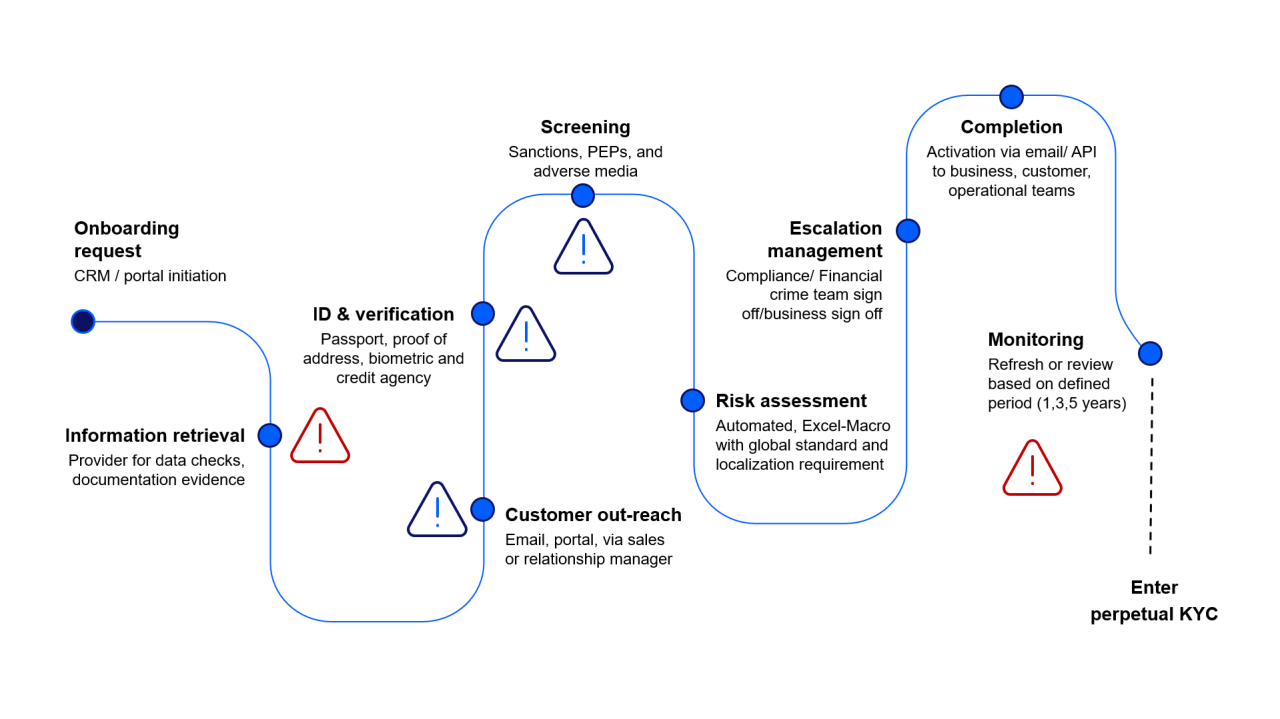
Traditional KYC is typically performed at onboarding and then refreshed at fixed intervals (e.g., every 1-, 3-, or 5-years based on risk rating). Looking at risks during a “snapshot” in time could leave gaps where customer data becomes outdated, increasing exposure to financial crime and compliance risk.
Key differences:
| Feature | Traditional KYC | Perpetual KYC |
|---|
| Frequency | Periodic (1–5 years) | Continuous, real-time |
| Process | Manual/semi-automated | Fully automated |
| Risk approach | Reactive | Proactive |
| Data freshness | As of last review | Updated dynamically |
| Analyst role | Reviews all customers | Intervenes only on alerts |
3. What are the potential benefits of Perpetual KYC?
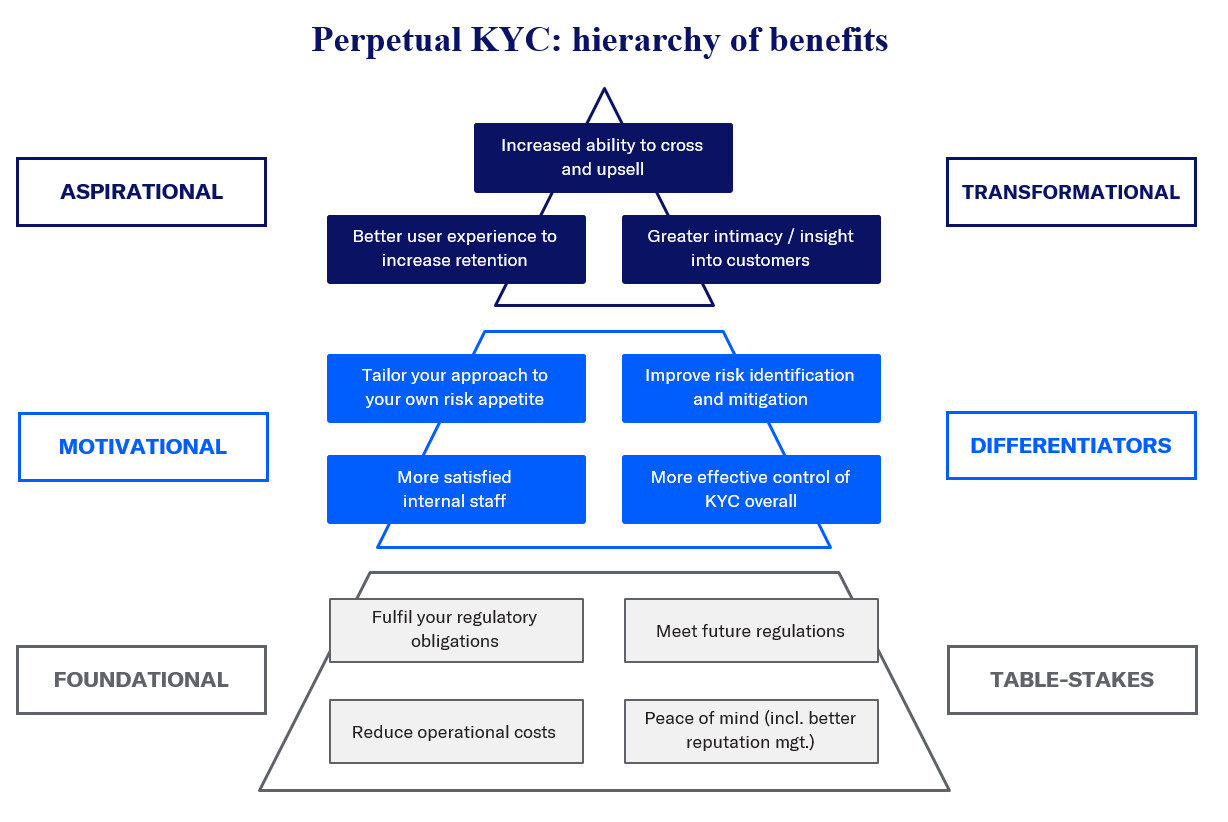
Benefits can include:
- Regulatory compliance: Meeting AML and customer due diligence (CDD) obligations more effectively.
- Risk mitigation: Detecting risks, including financial crime, faster.
- Operational efficiency: pKYC can reduce manual workload and remediation costs.
- Enhanced customer experience: There can be fewer requests to customers for documentation.
- Better insights: Supporting upselling and cross-selling through improved data quality and insights.
4. Are there drawbacks to Perpetual KYC?
While pKYC offers advantages, there can be challenges, including:
- pKYC frameworks vary across jurisdictions.
- A pKYC approach relies on high-quality, consolidated datasets.
- Technology investments including AI/ML systems and integration with existing workflows.
- Moving from periodic to perpetual monitoring needs buy-in from leadership and compliance teams alike.
- Handling large volumes of sensitive data requires strong encryption and adherence to global data protection laws.
5. Deciding on Perpetual KYC vs. Periodic KYC
Periodic KYC remains common but is increasingly becoming outdated, as it can create compliance gaps between reviews, leaving organizations more vulnerable to fast-changing risks. Perpetual KYC offers a dynamic, event-driven model that can be used to align with modern regulatory expectations and digital transformation goals. For organizations seeking agility and resilience, pKYC might prove a viable option to periodic review.
6. Are there challenges to implementing Perpetual KYC?
- Aligning a pKYC approach with legacy systems and AML platforms can present integration complexities.
- Introducing pKYC would require navigating various global compliance requirements.
- Maintaining data privacy and security are important to GDPR compliance and other data protection laws.
- Allocating resources is another consideration as adopting pKYC may require investment in technology and skilled personnel and adapting governance frameworks.
- Moving from more manual, periodic reviews to automated and dynamic monitoring requires change management and organizational readiness.
7. What’s the Moody’s difference with pKYC?
Moody’s delivers a holistic, data-driven approach to perpetual KYC, combining:
- Industry-leading entity data: Access to 600M+ companies and 1.7B ownership links across 200+ jurisdictions.
- Dynamic risk intelligence: Continuous monitoring for sanctions, adverse media, fraud and other risk indicators.
- Advanced automation: AI-powered workflows can help reduce manual intervention and support straight-through processing.
- Configurable solutions: Tailored to an organization’s risk policy, risk appetite, and compliance framework.
- Strategic partnerships: Integration with platforms like Fenergo for end-to-end customer lifecycle management.
Disclaimer: This content is for informational purposes only and reflects our understanding of the subject matter as of the date of publication. It does not constitute legal, regulatory, or compliance advice.