Maxsight™ Investigation can automate enhanced due diligence and investigations, unifying access to the diverse datasets analysts need, while digitizing workflows to improve productivity and uncover risk.

Fraud is evolving—defenses are too.
External fraud—a predicate offence to money laundering—presents significant challenges to organizations worldwide. An essential part of mitigating fraud-related risks is understanding who you’re doing business with, including hidden connections.
It’s important to verify that individuals and entities are who they claim to be during know your customer (KYC) activity and corporate onboarding. And, if a fraud-related risk occurs during the lifecycle of a relationship, continuous monitoring and timely alerts can support a swifter response.
How can Moody's help with your fraud risk management program?
If you would like to talk to us about your fraud risk management program, please get in touch with the team any time.



Turn fragmented data into focused action with a unified approach.

Maxsight™ Investigation can automate enhanced due diligence and investigations, unifying access to the diverse datasets analysts need, while digitizing workflows to improve productivity and uncover risk.

Shell Company Indicator detects signals linked to potentially fraudulent corporate behaviors. It provides insightful risk flags that support decision-making during due diligence and ongoing risk monitoring.

Moody’s offers access to a powerful global dataset on private companies. With data on more than 580 million entities, you can identify the beneficial owners, directors, and senior managers behind organization across the world.

In addition to accessing Moody’s leading verification datasets, you can integrate data from any of our alliance partners to perform identity and verification checks as part of a fraud risk management process.

Moody’s Entity Verification API provides entity data from a global network of commercial registers and financial authorities. This solution also includes access to a robust risk database via a single integration.

Build insights from negative news stories into your fraud risk management framework. Create risk profiles at onboarding and actively monitor third parties for vulnerabilities throughout the lifecycle of a relationship.
Moody's intelligent screening services can help you better identify where risks lie. Leveraging AI and machine learning to filter and name-match, receive alerts in near real-time on new fraud-related risks linked to your third-party network.
From onboarding to investigations to ongoing monitoring. Moody’s supports fraud risk management use cases by providing customers with robust, global data, intelligent screening, and an end-to-end case management system that helps teams maintain risk profiles.
Robust due diligence at the onboarding stage can help build a clearer picture of risk and reduce the likelihood of first-party fraud. Moody’s fraud-related adverse media data can be paired with applicant information to support faster, more informed decision-making. Our solutions also deliver intelligence via API integrations with a wide range of pre-connected partners—so you can streamline fraud risk management.
Integrated intelligence can connect entities to ownership structures and help link suspicious companies to support fraud investigations. Data-led insights—such as negative news related to fraud, conflicts of interest, or associations with shell companies—can be integrated into your workflows to support risk detection and decision-making.
Build a picture of risk with the unique risk engine and scoring technology in Moody’s Maxsight™. You can generate a profile for a third party, then view it for different purposes such as KYC, AML compliance, risk management, and more. Conduct thorough due diligence, while our AI-led screening flags fraud-related risks that teams can analyze to detect potential threats.




A unified risk platform for smarter, data-driven decision making.
Moody’s Maxsight™ platform brings together powerful data, advanced analytics, and intelligent automation in a single environment—helping you manage a wide range of risks.
Whether addressing fraud risk during KYC, monitoring third-party risks, or solving other compliance challenges, Maxsight™ supports teams to make decisions through centralized access to risk insights, built using customized workflows and up-to-date data.
If you would like to know more about Maxsight™, please get in touch any time.
Through our partnership with GBG, a leading provider of fraud prevention solutions, Moody’s has integrated advanced identity verification into its Maxsight™ platform—helping businesses streamline onboarding, mitigate fraud risks, and strengthen KYC and KYB processes within a unified risk management framework.


How are fraud prevention teams responding to increasingly sophisticated threats? This paper offers practical insights and strategies to help organizations better understand the answer to this question, highlighting the role of technology, collaboration, and shared responsibility in building long-term resilience.
Featuring expert perspectives from the UK’s National Crime Agency, HMRC, ING Bank, and more—you can download the paper today.
Fraud risks are rising—are you seeing the full picture?
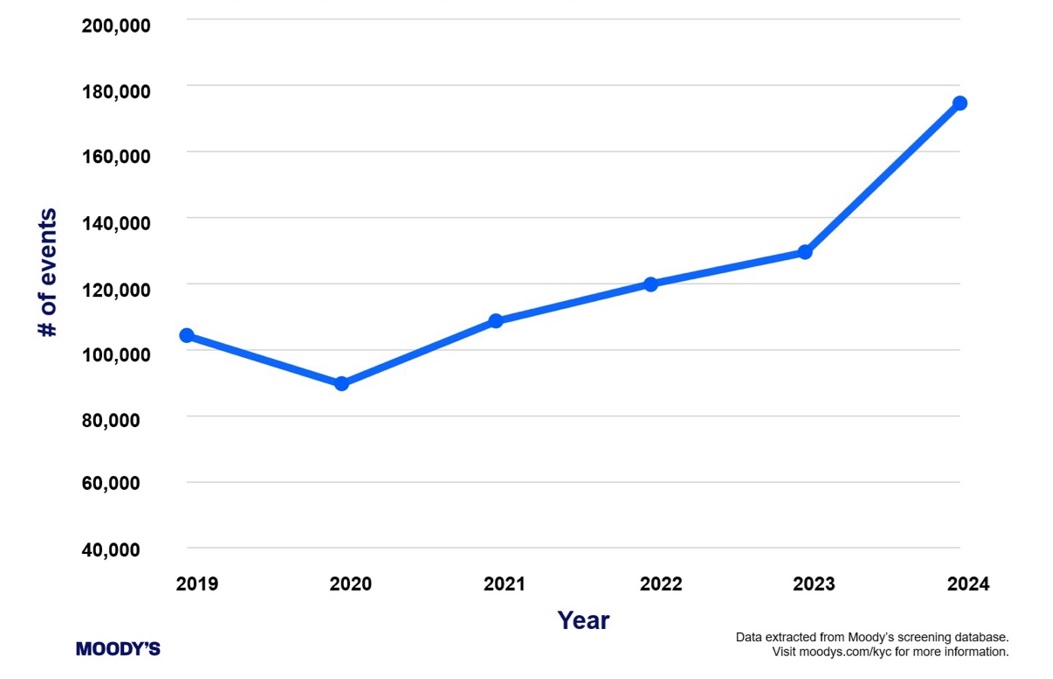
According to Moody's screening database, there were just under 180,000 fraud-related risk events in 2024, and the 5-year trend shows an ongoing increase in fraud-related alerts.

Fraud is a growing threat to financial integrity—and the UK is fighting back. In this episode, Moody’s Industry Practice Lead, Ted Datta, joins host Alex Pillow to unpack the UK’s new ‘failure to prevent fraud’ offence. They explore how this landmark legislation reshapes corporate accountability, who it applies to, and what organizations might need to do next.
Discover how a single crypto transaction unraveled into a $1.5B cybercrime in the audacious Bybit heist—where deception, digital laundering, and human error collided.
Chen Zamir, fraud strategy advisor and founder of the consultancy Native[risk]
David Thomas, Head of Product - Global Documents & Biometrics at GBG, and Paul Warren-Tape, Head of Risk and Compliance at IDVerse

From September 1, 2025, the “Failure to Prevent Fraud” offence—introduced under the UK’s Economic Crime and Corporate Transparency Act—will change the responsibility of large organizations when it comes to fraud prevention.
Download Moody’s eBook to explore:
Whether you are based in the UK or elsewhere, this eBook offers insights your organization may find useful—get your copy today.
The 3 main types are: Internal fraud, committed by people inside an organization; External fraud, committed actors outside an organization; and collusion (or hybrid) fraud, which involves internal and external actors working together.
External fraud refers to fraudulent activities committed by individuals or entities outside an organization. These actors—such as customers, vendors, hackers, or organized crime groups—exploit vulnerabilities in systems, processes, or relationships to steal assets, data, or gain unauthorized benefits.
Internal fraud is committed by someone inside an organization, like an employee or executive.
External fraud comes from actors outside an organization.
Both require different strategies within a strong fraud risk management framework.
Common types of external fraud might include:
Fraud is considered a predicate offense to money laundering because it generates illicit proceeds that criminals attempt to disguise as legitimate income. Money laundering involves concealing the origins of these illegally obtained funds, and fraud is one of the underlying crimes (or "predicates") that can trigger anti-money laundering (AML) laws and enforcement actions.
A fraud-related risk event can be thought of as an incident where an individual or organization is linked to fraudulent or criminal activity, typically identified through adverse media screening or independent verification. These events may then be considered red flags in risk management.
*This content is for informational purposes only and does not constitute legal, financial, or compliance advice.


In the ever-evolving world of cybercrime, 2025 has brought a sharp focus to a once-overlooked threat: job scams. While investment and imposter scams continue to dominate headlines, a quieter but equally dangerous fraud trend is emerging—one that not only drains victims financially but also harvests their personal data for more insidious purposes.

This article investigates the current state of fraud risk, the complications of managing those risks across a third-party network, the implications of new regulation, and the proactive measures businesses are taking for active fraud prevention.

Synthetic identities are created by combining real and fictitious information to generate a new persona by intentionally leaving a false digital footprint in social media and on public records. These identities are then used by bad actors to commit various types of misdirection, fraud, unauthorized access, and other illegal acts.
We would love to show you what Moody's can do! Get a demo or alternatively, keep reading to discover more about how Moody's can help you.