

Money laundering is the illegal process of taking money generated by criminal activity and making it seem to have come from legitimate sources by passing it through the financial system. Illicit proceeds can be laundered in different ways, and can involve large-scale organized crime activity across borders.
A slew of high-profile money laundering crackdowns in recent years show that tactics such as virtual currencies, online gaming, online marketplaces, blockchain technology, decentralized finance (DeFi), and financial grooming scams (sometimes referred to as 'pig butchering') are being used more often to launder illicit finances.
A 2025 report published by the United Nations Office on Drugs and Crime on the state of transnational organized crime groups in East and Southeast Asia estimate that the region lost approximately US$37 billion in cyber-enabled fraud in 2023.
With criminals using new technology and digital methods to launder cash, we explore these tactics, and the enforcement actions and regulations used to support AML and CTF efforts.
Money laundering typically comprises three stages: placement, layering, and integration.
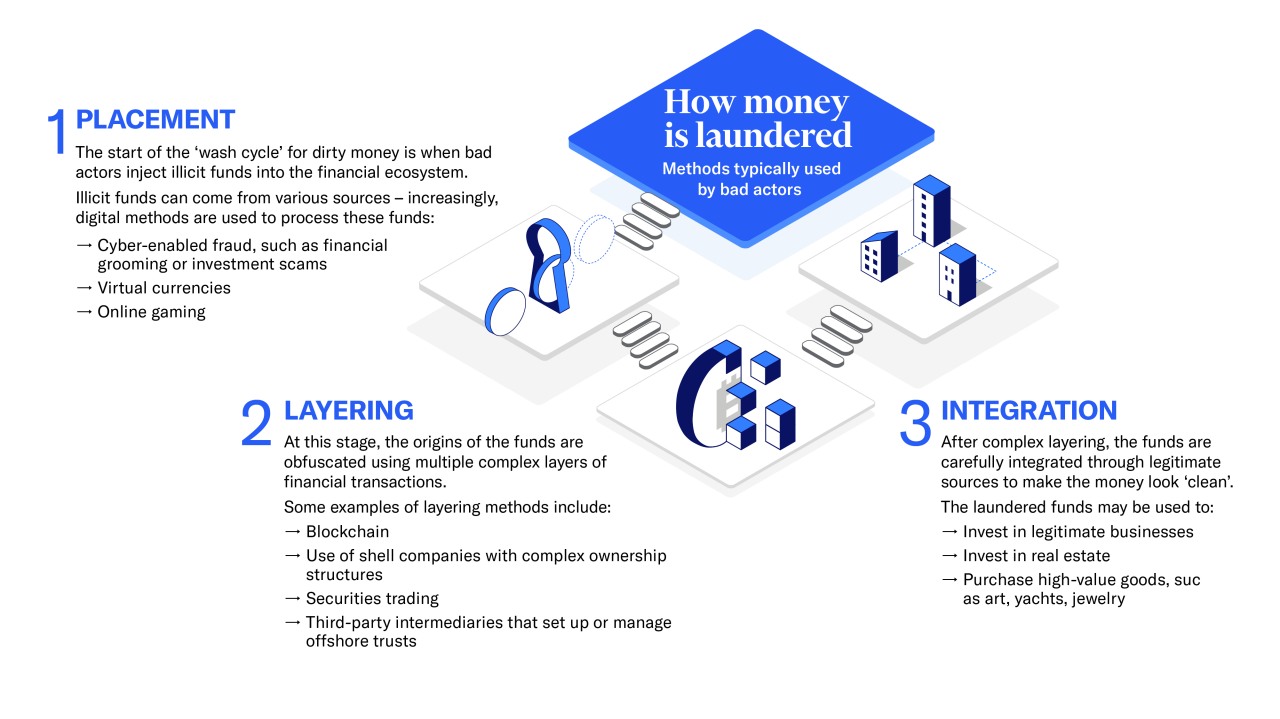
Placement
The start of the ‘wash cycle’ for dirty money is when financial criminals inject illicit funds into the financial ecosystem. These funds come from illegal sources, such as: drug trafficking, gambling, organized crime, fraud, and more.
Increasingly, digital transactions are facilitating money laundering activity. According to blockchain data firm Chainalysis, crypto crime from illicit transaction activity is worth an estimated $40.9 billion in 2024. Europol's European Union Serious and Organised Crime Threat Assessment report this year also highlighted the creation of a parallel underground economy by criminal networks, increasingly enabled by digital platforms and infrastructure, to launder money.
Layering
At this stage, criminals obfuscate the origins of their funds through multiple complex layers of financial transactions.
Besides the common red flags for trade-based money laundering, compliance professionals should look out for suspicious transactions from new layering methods:
Integration
After complex layering, the funds are carefully integrated through legitimate sources to make the money look ‘clean’. Once the money has been integrated into the financial ecosystem, criminals may use successfully laundered funds to:
In response to the growing risks posed by illegal use of cryptocurrencies, online gaming, and other sophisticated means of money laundering, FATF and national regulators have updated or added new AML/CFT measures, calling for more stringent know your customer (KYC) checks and enhanced due diligence.
In 2019, the financial watchdog updated Recommendation 15 to include virtual assets (VA) and virtual asset service providers (VASPs). FATF’s review in July 2024 revealed that 75% of the jurisdictions assessed against the updated standards are either non-compliant or partially compliant with the requirements. The report underscored the importance of recognizing the increasing threats from terrorist financing and proliferation financing, with both the public and private sectors encouraged to implement appropriate risk identification and mitigation measures. FATF’s 2025 report highlighted some emerging risks from criminal exploitation of virtual assets, which include the rise in stablecoin usage by illicit actors and the increase in the use of virtual assets in fraud and scams.
America: The American Gaming Association (AGA) expanded its AML guidance on best practices for AML and compliance to cryptocurrency, digital wallets, and online gaming among others.
Philippines: Philippines imposed a total ban on Philippine Offshore Gaming Operators (POGOs) in 2025 with the Anti-POGO Act of 2025.
Regulations are being extended to sectors outside of financial services in a bid to promote beneficial ownership transparency and mitigate money laundering risks. In this age of increased corporate transparency, the ability to identify beneficial owners and associated risks can be part of an organization's risk management strategy.
Australia: The Tranche 2 reforms under the AML/CTF Amendment Act to its AML/CFT regime was passed in Parliament in 2024, with implementation starting from 2026. The move aligns Australian law with international standards by extending customer due diligence processes to traditional “gatekeeper” professions and industries businesses – such as lawyers, accountants, real estate, trust and company service providers.
The Amendment Act also extends regulation to additional virtual assets-related services, aligning closely with the five virtual asset services named under FATF's Recommendation 15:
EU: The EU’s regulatory environment for beneficial ownership data has gone through fundamental shifts. Since the 2022 ruling of the Court of Justice of the European Union (CJEU) and subsequent adoption of the 6th anti-money laundering directive (AMLD6) and the AML Regulation (AMLR), regulatory expectations for obliged entities to identify and verify beneficial owners have increased.
Singapore: Under the Housing Developers Act, Singapore announced new AML/CFT requirements for property developers, mandating that appropriate due diligence checks must be done on new and existing buyers based on risk profiles.
Organizations are better equipped to mitigate risk when they have the data, processes, and workflows to support identification and verification of UBOs in their network.
Frequently asked questions (FAQs) on money laundering: What it is, how it’s done, and the common methods and typologies for laundering money.
Money laundering is the illegal process of taking money generated through criminal activities and making it appear as though it comes from legitimate sources. Criminal proceeds are usually moved through the financial system using various methods to disguise the illegal origin of these funds, with the intention of using these disguised funds without detection.
Money laundering is often a broader financial crime that can involve organized criminal networks or individuals that operate across different jurisdictions. As financial systems become increasingly digital and interconnected, money laundering typologies may evolve and present new risks for financial institutions, regulators, and the financial ecosystem.
Laundering money is when the illegal origin of criminal funds is concealed so that it can be used without raising suspicion. Money laundering typically occurs in three stages:
Together, these stages are meant to obscure the illegal nature of the funds and the proceeds generated from criminal activity.
‘Dirty money’ refers to funds generated through illegal activities. Common typologies of financial crime that generate illicit money can include: organized crime, drug trafficking, forced labor, illegal gambling, and fraud and scams.
Moody’s offers automated KYC and AML screening solutions that can be configured based on your organization's risk appetite and policies. Integrated with comprehensive data sets, the Maxsight™ unified risk platform can support more effective decision‑making for financial institutions by providing a more holistic view of risk.
Please get in touch to discuss your AML and CTF efforts, we would love to hear from you.