Politically Exposed Persons (PEPs) and their associates

A Politically Exposed Person (PEP) is an individual who holds a prominent public position. PEPs can include government officials, military officers, judges, senior sporting officials, and high-ranking executives of state-owned enterprises.

Due to their positions of power and influence, because of the key decisions they may make, and due to their access to financial resources, PEPs can be at higher risk of bribery and corruption. This elevated level of risk needs to be considered as part of your Know Your Customer (KYC) or Know Your Business (KYB) process.

Identifying Politically Exposed Persons is essential for compliance with anti-money laundering (AML) and counter-terrorist financing (CTF) laws. Most jurisdictions require that PEPs are subject to enhanced due diligence (EDD) and ongoing monitoring.


Moody's solutions can help identify PEPs in your network, streamline EDD, and support continuous risk monitoring.

  • Identify PEPs and their close associates
  • Understand connections between PEPs and business entities
  • Manage the dynamics of changing PEP status
  • Combine risk data for a real-time view of PEP risk

Get in touch to discuss PEPs screening using Moody's data and analytics tools.


How Moody's supports AI-driven, automated PEP screening


KYC workflow automations
KYC workflow automation

Orchestrate digital onboarding and perpetual risk monitoring for PEPs worldwide through a single platform. Build automated workflows to verify and screen individuals and entities. Integrate risk-relevant data on Politically Exposed Persons, sanctions, watchlists, adverse media, and more. If a PEP’s risk status changes, the system can flag it—triggering screening at any time, not just during periodic reviews.

PEPs risk screening
Screening for PEPs

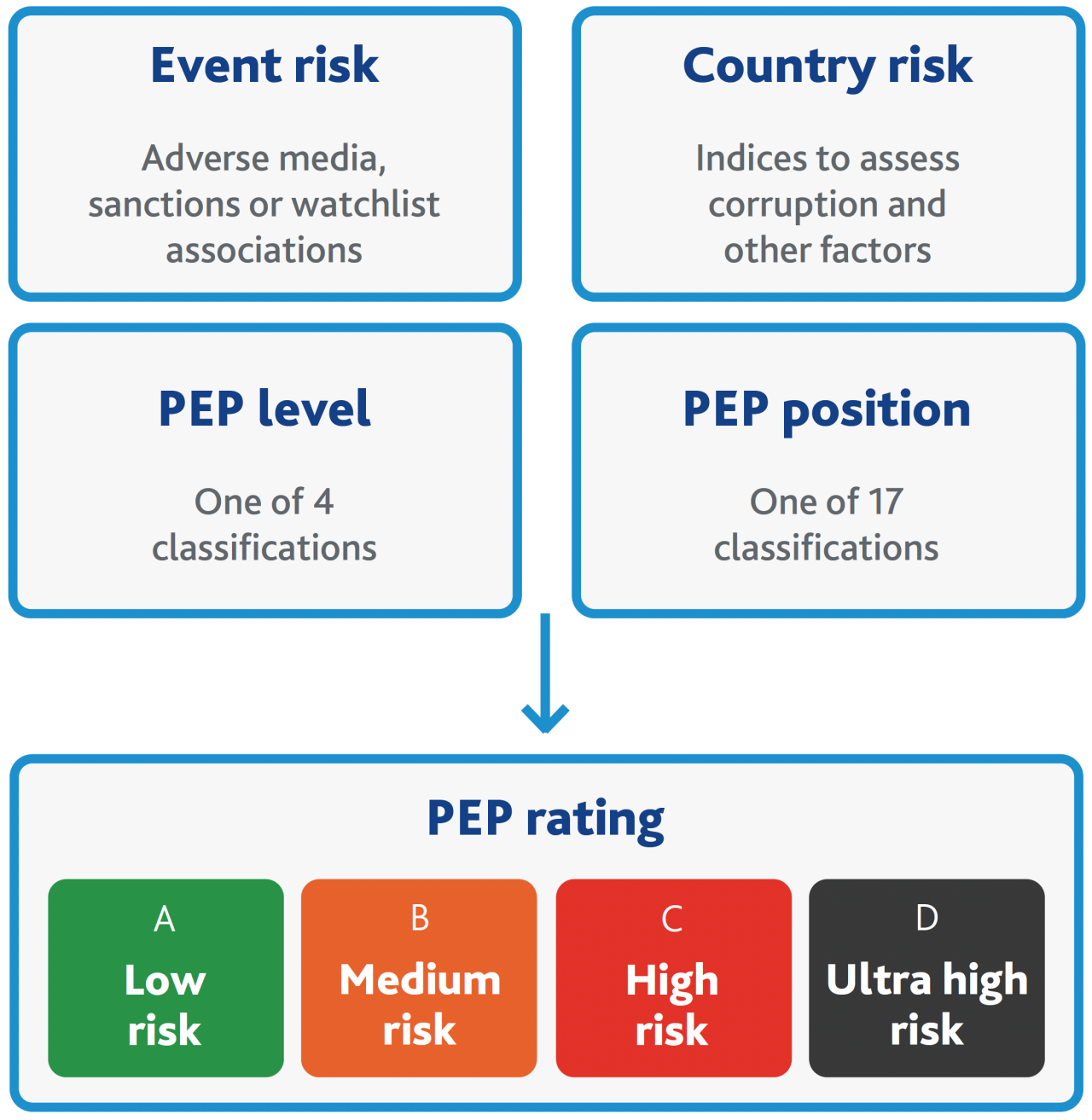
Our curated database continuously monitors thousands of sources for information on PEPs and PEPs by association. It compiles risk-relevant data into profiles that support automated KYC, AML, ABAC, and CTF processes. Our global PEP database uses a unique risk rating system that considers country, position, level, and event risks.

AI-enabled PEP review
AI-Enabled Screening

Our AI-powered tools use advanced name-matching and customizable filters to improve the identification of relevant Politically Exposed Persons. Automate alert processing and reduce false positives to enhance the precision of PEP screening and monitoring.


Smiling businessman wearing olive colored shirt looking at tablet

Benefits of smarter PEPs screening

Moody’s digitally transforms compliance workflows, helping to simplify the process of identifying and assessing Politically Exposed Persons (PEPs) and their associates.

With access to a global database of more than two million PEP profiles, you can better identify high-risk individuals, understand their connections, and track changes in their status.

Moody’s also uses advanced technology to improve the precision of PEP screening. AI-powered tools can help reduce false positives, so teams can focus on the most significant risks.

Combining data from sanctions lists, watchlists, and news sources, organizations gain a clearer, up-to-date picture of PEPs risk—helping you protect your organization from financial crime and reputational damage.


Discover Maxsight™: Unified Risk Management in one platform


Take your compliance strategy further with Maxsight™—Moody’s unified risk management platform. From screening Politically Exposed Persons (PEPs) to monitoring sanctions, adverse media, and beneficial ownership, Maxsight™ brings all your risk data together in one place.

Gain a more holistic view of customer and third-party risk, streamline workflows, and make faster, more confident decisions with dynamic insights.

Ready to strengthen your approach to risk management?


Moody's Maxsight™


Assessing PEPs risk

Moody's has data on 2+ million PEPs worldwide

Moody's Analytics has data on more than two million PEPs worldwide


Frequently asked questions

Everything you wanted to know about PEPs


A Politically Exposed Person (PEP) is an individual who holds a prominent public position. PEPs can include government officials, military officers, judges, senior sporting officials, and high-ranking executives of state-owned enterprises.

PEPs are considered as being at higher risk of bribery and corruption, as well as presenting an elevated risk of terrorist financing because they have the power to influence governments, key decisions, and they may have access to significant financial resources.

Because a PEP could abuse their position of power, or be coerced to engage in corrupt activities, such as accepting bribes or embezzling public funds, laundering money, or financing terrorist activities, they can pose a risk to businesses who work with them. The prospect of them being manipulated or blackmailed therefore needs to be considered in a KYC process.

Identifying PEPs is essential for compliance with anti-money laundering (AML) and counter-terrorist financing (CTF) laws. Most jurisdictions’ regulatory requirements state that PEPs must be subject to enhanced due diligence (EDD), including ongoing monitoring. By identifying PEPs, organizations can better assess the risk of doing business with them and take appropriate action to mitigate that risk.


A Politically Exposed Person (PEP) by association is a person who is not a PEP themselves but is closely associated with a PEP, such as a family member or business partner. PEPs by association are considered to be at higher risk of being involved in financial crime, such as bribery and corruption, due to their close relationship with a PEP. Organizations need to identify PEPs by association in their business network to mitigate risk and comply with anti-financial crime regulations.

Identifying PEPs by association is important for organizations subject to anti-money laundering (AML) and counter-terrorist financing (CTF) regulations. Organizations implement enhanced due diligence (EDD) measures to understand and monitor ongoing risks linked to those who are PEPs by association. EDD includes identifying when a PEP is a beneficial owner or controller of a legal entity, monitoring suspicious activity, and reporting suspicious activity to the relevant authorities.

It’s essential for organizations to have robust procedures to identify and manage PEPs and their associates. Failing to identify and manage risk effectively can result in fines for non-compliance and reputational damage.

To identify PEPs, regulated businesses conduct a process of enhanced due diligence (EDD) involving data checks. These screening checks may include reviewing public sources of data such as government websites, media reports, and international lists of PEPs. They may also rely on information obtained through third-party providers, like Moody’s, or data and declarations provided by the customer/supplier themselves.

Once a PEP has been identified, regulated businesses must build a risk profile for the individual considering factors such as their position, country of origin [domestic verses foreign PEP status], associated negative news stories, and business ownership activities. Organizations use a range of data checks and sources to build risk profiles and keep them up to date. This risk assessment informs decisions about working with a PEP, and the level of ongoing monitoring required.

Regulated businesses must monitor PEPs for ongoing and changing risk factors. This usually happens by integrating automated screening and data checks to refresh a PEP’s risk profile. Data checks that feed into a PEP’s risk profile can include confirmed alerts for sanctions, watchlists, fraud or other forms of financial crime, and negative news stories. Many organizations choose to employ a method of perpetual KYC (pKYC) for PEP screening and risk monitoring instead of periodic reviews as allowing long periods of time to elapse between reviews can leave significant risk undetected. pKYC is used to conduct automated checks and update risk profiles in real-time. 

From the moment someone is elected to power or is appointed to a senior public/prominent role, they can be considered politically exposed, and this is when they become a PEP. Election or appointment is also when relatives, partners, and so on become PEPs by association. Marriage, divorce, births, deaths, and changing business partnerships also impact PEP and PEP by association status. There are however different PEP definitions around the world in different jurisdictions. Consequently, there is no globally accepted definition and often local rules apply.

The definition of when someone stops being considered a PEP varies from country to country and institution to institution. However, in general, a person stops being considered a PEP when they no longer hold a relevant public position or function. This can happen when they resign from their post, retire, or aren’t re-elected for example.

It is important to note that the status of a PEP can also be extended to family members and close associates, and people may continue to be considered as PEPs even after they have left their position. This is because they may still have access to resources and information that could be useful in illicit practices. Furthermore, they may still be able to exert influence or undue power over the actions of other senior or elected officials.

Overall, the determination of when someone stops being considered a PEP is complex and organizations need to give this careful thought and match their approach to PEP status with their own risk appetite. Many Financial Institutions (FIs) for instance adopt the approach of “once a PEP, always a PEP”, but this can vary significantly across organizations required to screen PEPs and PEPs by association. 


Articles and insights

More reading and resources

Let's talk about PEPs

In this episode of our KYC Decoded podcast, we’re pleased to welcome PEP experts Colleen Dychdala, Head of PEP data and premium content for Moody’s KYC, and Eric Almbladh, who built the leading PEP database for the Nordic region acquired by Moody’s in 2021. Their conversation with host, Alex Pillow, tackles the complexities of PEP risk management.


PEPs screening using integrated risk assessment

Politically Exposed Persons or PEPs can be tied to various areas of financial risk – such as fraud, corruption, money laundering – making it important to understand if someone is a PEP before they are onboarded to your customer or supplier network. And, as PEP status can change with some frequency, it’s also imperative to know where PEPs exist across your entire customer base/business network.


UBOs (Ultimate Beneficial Ownership) and the fight against money laundering

How is an ultimate beneficial owner defined? How do ultimate beneficial owner (UBO) disclosure requirements differ across the world? What information, if any, needs to be collected for due diligence, and where does that data reside? It is time to take stock of the world of UBO definitions, disclosures, and data—and consider its role in the fight against financial crime and money laundering.


Moody's study

The public's understanding of PEPs and PEPs by association

It’s important for regulated organizations to understand which PEPs and PEPs by association are in their business network. Considering PEPs most often hold public office, work in government, or serve state-owned organizations is there enough public understanding of what constitutes a PEP? Why PEPs might be considered a risk? What makes a PEP by association? And why they might be thought of as high risk?

With global consumer research on PEPs encompassing the US, Europe, and Asia, we garnered new insights showing:

  • Only 45% of respondents said they know what a PEP is
  • Fewer than 50% of respondents correctly answered that a person can be a PEP by association
  • 33% incorrectly believe having a friendship with a PEP would not qualify someone as a PEP by association


Get in touch

Request a demo

We would love to show you what Moody's can do! Get a demo or alternatively, keep reading to discover more about how Moody's can help you.